Back to the Future Part 2 Roger Ebert Review
 | |
| |
| Comments count:0
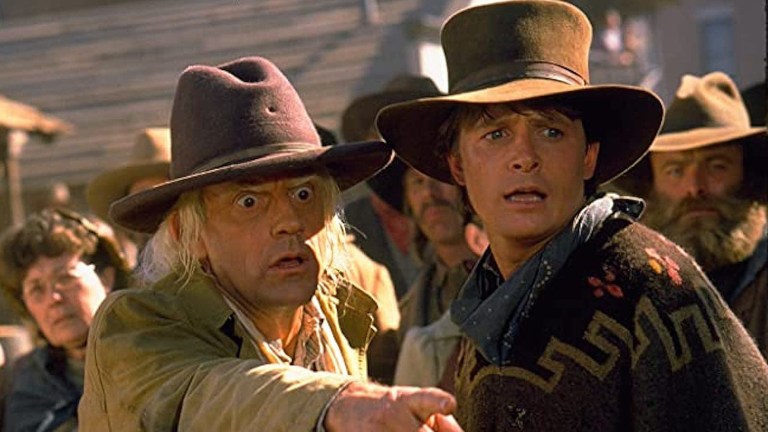
In his original review for Back to the Future Function 2 , Roger Ebert (the Blastoff and Omega of film criticism) chosen the movie "an do in goofiness, an circuit into various versions of the past and futurity that is so baffling that even the characters are constantly trying to explain it to each other."
Although his review was largely a positive one, his sentiments echoed those of audiences who felt that Function 2 was an exercise in dodge — one marked by baffling character choices (Marty's sudden aversion to being called "chicken," every line reading Thomas F. Wilson does as Griff, etc), strange plot details (ditching Jennifer from the story), and the overwhelming darkness of the alternative 1985 sequence, and a cliffhanger ending that sidelined the feel skillful elements of the first film for something strange and unfamiliar. Which is exactly what a sequel should do, i.e. The Empire Strikes Back .
Cut to 2020 and all of u.s. are living in the Biff Tannen's Pleasure Palace timeline, then the film seems much more plausible. More than that though, the subsequent 31 years since Back to the Future Part Two' s release accept allowed viewers to capeesh the pic on its own merits. It's a weird flick to be sure, and 1 that has no interest in repeating what has gone before — except when it is literally doing so during the 2nd visit to the Enchantment Under the Sea dance, and even then it is rewriting the rules of fourth dimension travel films. Or, better still, making them upwardly as it goes along, which results in Back to the Future Function Two being an extraordinarily aggressive sequel even with its flaws.
The rug was farther pulled out from audiences when it came fourth dimension for Back to the Future Role Three . Set almost entirely in 1885, the pic primarily centered on Doctor Brownish'due south budding romance with schoolteacher Clara Clayton (the keen Mary Steenburgen). Whereas Role 2 feels like a kinetic, buzzy viewing feel, the final chapter is virtually a grapheme study that delves deep into who Medico and Marty actually are. The final message that the future isn't written still, delivered past Doctor every bit Clara and his twin boys, Jules and Verne, stand by felt both uplifting and an undoing of the point of having the sequels exist in the first identify.
Three decades later and Dorsum to the Futurity Office III feels like what sequels should aspire to be. Information technology builds drama at a gentle stride, allowing grapheme moments to have center stage. Writer Bob Gale and Director Robert Zemeckis knew this would be the terminal fourth dimension we'd hang with these characters, and and so they gave audiences moments that illustrated how important Marty and Dr. are to each other. The activity sequences remain dazzling, and the one time divisive closing scene now feels like the best, most natural ending.
We recently talked with Bob Gale about how people responded to the sequels, and he gave us some insider knowledge into his thoughts on how the films were marketed and received.
"Remember, back in 1989, when Back to the Futurity Office II was released, we had no net," Gale says. "In that location was no such thing as social media, none of this stuff. If you wanted to detect out what was coming to the movies, you lot had to become to the movies and watch the trailers. You had to expect for a Television receiver spot. Maybe there was a movie magazine that would tell you something well-nigh an upcoming picture show. But now, everybody knows everything almost what movies are supposed to be coming out, pandemic excepted, of form. Then we never know when anything's going to come up on now."
Read more than
And even though the first moving picture made it clear a sequel was planned, keeping that going was a challenge for the second one.
"The biggest fight that I had with the president of Universal when we were planning the release of Role Two is that I was adamant that I wanted to advertise this every bit role ii of the 3-part Back to the Future series, role two of the trilogy, and he didn't want to do that," Gale says. "He but wanted to say, 'This is part two. Let them find out about part three afterward.'"
But ultimately, it was the memory of i of the great sequels of all time that convinced Gale what the right thing to exercise was.
"I call up walking out of the screening of [ The Empire Strikes Back ] thinking, 'What the hell kind of ending is this? Han Solo's in carbon freeze. That's no adept. And what is that? What is that?'"
Just you take to go back further for even more inspiration.
"Richard Lester had directed The Three Musketeers , the very best version of The Iii Musketeers . At the end of The Three Musketeers , there's a trailer for The Four Musketeers ," Gale says. "I remember sitting in the theater saying, 'Oh my God, that flick was so practiced. And expect at it, at that place'south going to be another one. And they're showing me 45 seconds of it and it looks and then great. I can't wait. How am I going to wait a twelvemonth to encounter you The Four Musketeers ?' So that really was what gave u.s. the idea to put a trailer for Back to the Time to come III at the very stop of Office Ii , considering we wanted everybody to know, yeah, nosotros're leaving you on a cliffhanger, simply there's going to be a tertiary one and it's almost finished."
But that still didn't change the perception of Part II in the moment.
"I call back that if we had promoted Part II more equally a function of a trilogy, people would have been more than accepting of Part 3 for what it was, and for Part Two for what it was, because people were disappointed in Part II because of the ending," he says. "In that location were a lot of people who said, 'Oh, that's a rip-off catastrophe. I'm not even going to get bother to run into Office III .' Well, of form, now everybody knows there'southward three Back to the Hereafter southward, right? You're going to become buy the movie. You end up ownership all iii of them, then of course you're going to lookout man all three of them. They're all beautifully interwoven and the more yous see them, the more you see how we set stuff upward in each flick that pays off later on on. Then people really appreciate the trilogy as the way we always hoped that it would be appreciated."
When watched back-to-back-to-back, the Back to the Time to come trilogy feels groundbreaking. Three films that explore unlike parts of Hill Valley's history, with Marty and Md forepart and centre equally your guide to the diverse fourth dimension periods. While the sequels may not have been given the credit they initially deserved, that is no longer the case.
The 3 Back to the Future films are cultural touchstones, each with their own merits. Even every bit you read this someone is discovering these movies right now thanks to a new Ultimate Trilogy 4K release. And whatever the future holds for any of us, one thing that you can depend on is Marty and Dr.'s adventures will remain delightful.
robinsonnevery1973.blogspot.com
Source: https://www.denofgeek.com/movies/how-audience-responses-to-the-back-to-future-sequels-have-evolved/
0 Response to "Back to the Future Part 2 Roger Ebert Review"
Postar um comentário